Section 8 search-warrant procedure
Blow OutThe Section 8 search-warrant procedure is the legal mechanism Jo turns to when the investigation needs access to a suspect’s home that cooperation cannot provide. Its importance in the story lies not merely in authorising a search, but in the judgment that precedes it: suspicion may justify applying for a warrant even when the evidence remains short of proof, especially when waiting could endanger lives.
Investigative Context
Jo’s approach to investigative work is shaped by the Murder Investigation Manual, which she consults through a laminated digest of checklists and diagrams. She treats investigative strategy as a set of key elements that must be accounted for, from the crime scene and forensic examination to post-mortem arrangements. This procedural framework places a warrant application within a wider process of managing evidence rather than treating it as a shortcut to a solution.
The investigation has accumulated leads without yet identifying a suspect conclusively. Jo reports an extensive list of people who may have held a grudge against either victim, but no names common to both lists. Investigators also have partial boot prints and a piece of fabric from a Manchester crime scene, alongside hours of passive media footage, chiefly from fixed-speed and ANPR cameras. These strands are being worked through, but their quantity does not itself resolve who carried out the attacks.
Threshold and Decision
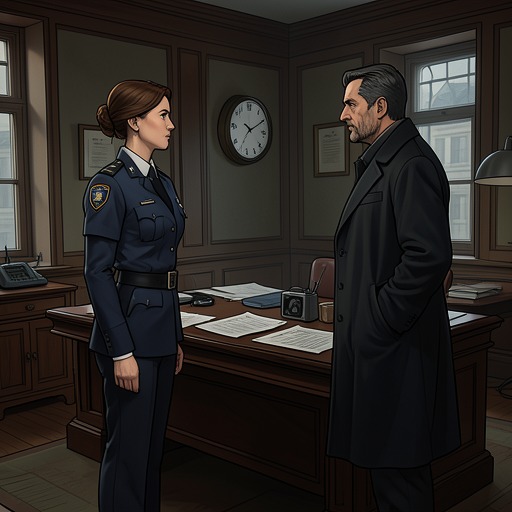
The warrant question becomes urgent when Nick proposes a thorough search of the suspect’s home under a Section 8 warrant. He argues that the police have reasonable cause and cannot obtain the evidence they need without searching. Jo initially resists. She has met the suspect and considers him smart, calm, confident, and possibly arrogant; because he knows the police regard him as a suspect, she believes anything incriminating may already have been destroyed or moved. Their earlier search of his house produced nothing that connected him to the attacks.
Nick’s counterargument turns on uncertainty rather than certainty: apparent arrogance does not necessarily mean a suspect has covered every trace. Jo accepts that reasoning after weighing the consequences of inaction. If the suspect is responsible, a renewed investigation could at least force him to stop or slow down, potentially protecting someone while the police gather stronger evidence. The procedure therefore functions as an intervention under risk, not as a declaration that guilt has been established.
Application and Authorisation
The evidential picture subsequently strengthens, though it remains incomplete. Jo describes evidence that the suspect stole the identity of a former student friend to buy, license, tax, and insure a car later placed near two crime scenes at relevant times. The senior officer characterises the combination as motive and opportunity, while identifying the missing air rifle as the evidence needed to establish means. Jo says she is heading to Nexus House to complete a Section 8 application and assemble a search team.
Helen Gates offers to handle the warrant application herself, reasoning that this will be quicker. She will call once a magistrate has signed it, and Jo can collect it from Central Park HQ. The exchange shows the application as a coordinated institutional step: Jo identifies the need and prepares the operational response, while Gates takes responsibility for obtaining judicial authorisation. The warrant is not portrayed as automatic merely because investigators suspect someone; it must be signed by a magistrate.
Search and Limits
The later search illustrates the gap between authorisation and discovery. Initial searches of the suspect’s home are negative. The dog handlers find no trace of weapons, drugs, or the substance under investigation, and Jo is preparing to send in a biohazard forensics team. A warrant can secure access to a place and permit investigators to pursue evidence, but it cannot guarantee that relevant material remains there or that a search will produce a result.
That limitation echoes a broader distinction the novel draws between reasonable suspicion and evidence capable of proving a case. Andy Swift observes that both the slow-burn revenge theory and the professional-hitman theory remain possible partly because the material connecting Darren Clements to the attacks is still limited: the suspected identity theft and the car’s presence near two scenes support investigation, but do not by themselves establish the case. The warrant procedure thus marks a lawful escalation in inquiry while preserving the uncertainty the investigation still has to overcome.